Birthing the Republic of Ireland
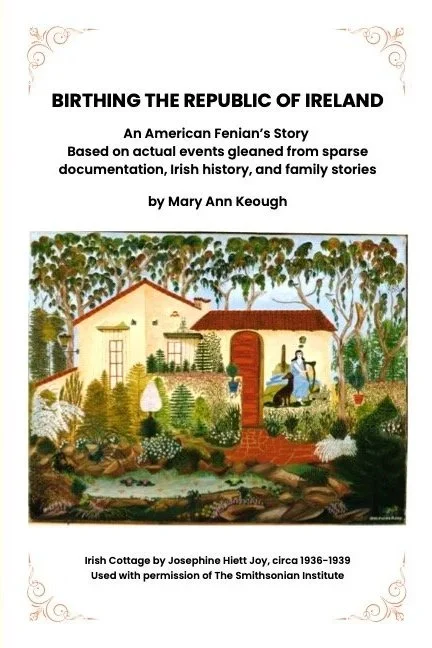
Irish Cottage painting by Josephine Joy. Used with permission of The Smithsonian Institute.
An American Fenian’s story
Birthing the Republic of Ireland brings to life the little-known story of Frank Bradley, a young Irishman who fled post-Famine Derry, landed in turbulent New York City, joined the Fenian movement, and fought in the U.S. Civil War—a service he never revealed to his family. After settling in Illinois, he built a successful life while quietly supporting Ireland’s independence efforts.
Interwoven with this history is the artistic legacy of Josephine Joy, Bradley’s fourth wife, whose painting Irish Cottage—now in the Smithsonian Institute—appears on the book’s cover.
Mary Ann Keough’s discovery of her great-grandfather’s past began with a simple prayer: Please, God, let me do something to honor my great-grandfather. Then followed an unexpected encounter that brought her to serve with a Peace Camp for Children of Northern Ireland. Later she met adults impacted by the Troubles. Her acquaintance with Fr. Gerry Reynolds and the staff at Cornerstone in Belfast, deepened her exploration of the book’s themes of legacy, reconciliation, and faith.
Part history and part personal journey, Birthing the Republic of Ireland honors the Irish-American contributions to Ireland’s struggle for freedom and celebrates the enduring ties between ancestry, identity, and hope.
Post-Script
The discovery of this story is just as intriguing as the story itself. I knew nothing of my Irish ancestors. But I do know that many cultures (not the United States) treasure ancestors who help them from beyond. So, I said a prayer to God: Please, God, let me do something to honor my Irish great-grandfather. And the following is how God answered:
Three weeks later I was at a hospice conference and a woman introduced herself as an attorney-social worker. I was teaching nursing at Western Michigan University at the time and had the summer off with pay. She explained that she had spent her career traveling to refugee camps around the world to help children, orphaned from war, get adopted. For the past 10 years she had been conducting peace camps for children of warring factions in Sarajevo. The government of Northern Ireland invited her to conduct a Peace Camp for their Catholic and Protestant children exposed to community violence. I knew immediately that this was God’s answer to my prayer. “Do you need a camp nurse?” I asked. She said: “Yes”. God’s answer became more than I could ever imagine.
We met clandestinely outside Belfast to finalize camp plans. British troops still occupied Northern Ireland and a military helicopter swooped down on our car as we returned to Dublin. It was intimidating. We bussed 100 Catholic and Protestant children to Galway City for a 10-day Peace Camp. The following summer, I invited four children from the camp and their Irish leader to visit me in Michigan. They stayed for two months and attended the newly formed Grandville Avenue Arts and Humanities in Grand Rapids. My hope was to replicate the organization in Belfast so that Catholic and Protestant children and their families could engage in activities together year-round. That hope never materialized. God’s plan was something more.
Ten years later, I received a phone call from one of the Protestant children now an adult. He lived and worked at Cornerstone, a ministry affiliated with the Clonard Monastery in Belfast. Cornerstone was founded by Catholics and Protestants who had been traumatized by the Troubles. It was a retreat house of peace, forgiveness, and reconciliation. I visited my friend there several times over a period of years and researched my great-grandfather’s story.
At Cornerstone, I was blessed to meet with Fr. Gerry Reynolds each time I visited Belfast. He was a Redemptorist priest who lived at Clonard Monastery about a mile’s walk from the house. As a founding member of the ministry, he would come to the house weekly to pray with the staff and community. Once he rang the doorbell with tennis shoes in hand and invited me to take a walk in the hills around Belfast. Another time he drove me on a tour of all the churches where he had said Mass. Another time he took me to the Adoration Sisters convent for tea at 10pm. We were warmly welcomed despite the hour! The convent was next door to Sein Fein headquarters. The Sisters told harrowing stories of the Troubles. British military helicopters swooped down in the middle of the night and shone lights in the convent windows. One Sister fled back to Dublin in terror.
Fr. Gerry is remembered as a key person in formulating the current peace accord in Northern Ireland. He spent his life in Belfast promoting unity between Catholics and Protestants. I still regret not being able to come to Belfast for his funeral.
The Redemptorist Fathers asked Gladys Ganiel, a sociology professor at Queen’s University, to write a biography of Fr. Gerry’s life. She published his story after he died. Her book is called Unity Pilgrim. It is available through the Redemptorist Press in Ireland.
Fr. Gerry worked tirelessly for the poor and marginalized. Touchpoints of his story for me were his courage in peacemaking, his ministry to the marginalized (tinkers, especially), his involvement in the ministry of Charles de Foucauld, his withdrawal by sabbatical to pray and regroup, his visit to the Holy Land, and his walking the Camino de Santiago. (I had read Robert Ellsberg’s Foucauld biography, visited the Holy Land, and walked the Camino before reading Unity Pilgrim.) So, put on your tennis shoes and read Professor Ganiel’s book!
The book Birthing the Republic of Ireland is intended to continue to honor my great-grandfather, his life and purpose. His story represents 150,000 to 180,000 Irishmen who fought in the U.S. Civil War. See links to purchase Birthing the Republic of Ireland within this website.
More about visits to Ireland: On one visit to Cornerstone in Belfast, I discovered that Fr. Gerry was giving a conference. I told him I wanted to attend but did not have transportation. He told me to come to Clonard Monastery. The driver was his friend Ken Newell. Fr. Gerry and Ken sat in the front seat, and Mrs. Newell and I sat in the back. When we got there I was treated with great deference because I came with the two speakers. They wouldn’t let me pay. The love extended to the two of them by all present was palpable. How does this happen in a community of violence? Fr. Gerry and Ken Newell were courageous peacemakers. Fr. Gerry’s mantra was Iosa gra.
Two of my visits to Ireland were with choirs. One was the Grand Rapids Symphony Choir. We sang at the cathedral in Dublin and were invited to the rectory for tea. It was because of the talent of our choir leader who is an accomplished composer. We did not go to Northern Ireland that visit because the travel agency refused to send us there.
On the second trip it was with Fr. Jim Marchionda, a Dominican priest and composer. His Dominican Festival Choir toured a different country in Europe once every 3 years. This trip DID include Northern Ireland. In Galway City, we gave a concert and I got to visit the high school where the Peace Camp for the Children of Northern Ireland was held. It was many years later. There was no longer any evidence of that special camp. The peace mural the children had painted on an outside wall had been painted over. And Fr. Rabbit was no longer there.
I recalled past visits while walking around Derry several times visiting churches in search of evidence of my great-grandfather’s baptism, marriage, or church membership. Midday weekdays I’d find 40 or more people kneeling throughout the pews in prayer. The piety touched me. It was not that way in the Republic of Ireland. Something about the powerlessness of living in community violence makes a person connect with God more often and fervently.
In Belfast we sang at Clonard Monastery. Fr. Gerry spoke to our group after Mass. One of the choir members asked him: “How bad is the violence? Can you give an example?” Fr. Gerry looked down, took a deep breath, and said: “A group of Protestant teenage boys confronted a five year old on the street. They asked him to say “h” because the way that Protestants say “h” is different from the way Catholics say “h”. The little boy got all shook up and said the “h” in the Catholic way. The boys beat him to death. It turned out that little boy was Protestant.
Two more short stories where God connected the dots for me and Northern Ireland: When Fr. Gerry and I walked the hills of Belfast, he was very concerned that my sandals were not sturdy enough. I said: “That’s okay, Fr. They are so comfortable, I feel I’m walking on clouds.” In Professor Ganiel’s book Ch. 27 the title references a song written about Fr. Gerry by members of Fitzroy Presbyterian Church: “Gerry, Gerry, he can do it - with his feet planted firmly in the clouds.” Fr. Gerry knew about this song when we were walking in the hills. He may have connected the dots as I do now….but he said nothing.
In 2010 I had the privilege of traveling on a Peace and Reconciliation Pilgrimage with some Paulist Fathers to Northern Ireland, London and Coventry, England, Geneva, Switzerland, and Taize, France. We spent the first night in a hotel in Belfast with great concern. We were going to Londonderry the next day. That day while we were still in Belfast, the British government was meeting with family members in Derry who had lost loved ones in the Troubles. The meeting with families was in advance of making a British Parliament study of the Troubles public. There was the chance of rioting in Derry the next day depending on the results, but we still planned to go. The British government told the truth. The people’s march in Londonderry that sparked the Troubles was a peace march modeled after Martin Luther King’s peaceful protests in the United States. After the marchers were shot and killed, some of the British soldiers planted guns on the dead bodies and claimed they were IRA soldiers instigating a revolt. There was peace in Derry that next day we visited. Truth calmed hearts - but the painful memories remain.
Reflection: Reasonable people seek justice and peace. When oppression is prolonged, violence results. So much unnecessary suffering driven by fear and anger. A predictable downward spiral. The Troubles was a consequence of planting 400,000 troops in a small six-county area of a country: armed military vs unarmed civilians. (Some U.S. cities are currently besieged in this same way in 2025 and 2026.) History teaches wisdom which is idiotic to ignore. Professor Ganiel’s book Unity Pilgrim is a blue-print of how to become a peacemaker.
More on that trip with the Paulist Fathers: When we visited Coventry, England we visited an Anglican cathedral that was bombed in WWII. Coventry was the manufacturing center of England, so Hitler chose to bomb that city first. After WWII ended, Allied bombers destroyed a hospital in Dresden, Germany. So the people of Dresden, Germany and the people of Coventry, England got together. The people of Coventry helped Dresden rebuild their hospital and the people of Dresden helped Coventry rebuild their church. Coventry left the remnants of the bombed church intact to deter such destruction in the future. One remnant was a cross.
The people of Coventry founded an organization called Cross of Nails to honor peacemaking organizations around the world. At the time of our visit to Coventry, there were 180 member organizations. I leaned forward to read the list of them and there very near the top of the list was Cornerstone in Belfast, Northern Ireland. Cornerstone was sold after Fr. Gerry died and no longer exists. The founding board members aged and the peace accord was signed. But in its time it served its purpose, which hopefully each of us is called to do. Father Gerry’s hope was that the Cursillo movement would be a means of continuing dialogue between Catholics and Protestants to promote unity.
One final thought (I promise). The Peace Camp for Children of Northern Ireland for me was evidence of the Cosmic Christ. Why do I say that? Who is He? He is the Word that existed before creation, Who became human, Who died and rose again. Who in doing so, as said in Scripture, REDEEMED ALL OF CREATION. He reigns as King of Heaven and Earth. He sent us the Holy Spirit to build His kingdom till the end of time. What is the evidence? The organizer of the Camp was a Jewish woman whose core team was Jewish and hailed originally from Hawaii. One member of the staff was a Muslim from Jordan. He was there because of his religion’s requirement to serve others. The Jews and a young Muslim man were serving Protestants and Catholics, all of us descendants of Abraham.
Activities included nature: the five year-olds collected sand from the Galway City beach. The sand was brought back to the Camp and placed on cafeteria trays. One of the staff had brought a suitcase full of little toy figurines. Each child was invited to build a scene on their tray of sand. Then staff interviewed them about what they created. It was a way for a small child to express the community violence they had witnessed through play in a safe place. The climax of the Camp was a Hawaiian luau. By that time the children had completely opened up to the joy and belonging of the experience. We were one family in the spirit of ALOHA: love and unity. Truly cosmic!
Explore snapshots of the people in this Irish story, Birthing the Republic of Ireland - an American Fenian story.